Thursday, July 16, 2015

607 Captured Live-Edge

607 - Unique in the industry, a "captured live-edge" dresser features solid panels joined on the vertical

Designed by me and built by Buck for a friend / colleague.  51 L x 24 w x 65 1/2 h.   A departure from our usual but we are  totally comfortable with this style and medium.  This piece in our opinion begs to sit alongside an entire body of work.


The woods used are Oregon Walnut on the dark side, and Oregon Myrtle on the light side.  Eastern Walnut top and base.


Right side.
Here it shows some of  the crazy boards we used for this project.  These were all considered "seconds" and not much better than throwaway wood.  Thicknesses varied widely within each board from one end to another, and there were some unusable places that had to be cut away.  The dresser was built as a demonstration of the fact that curvy boards can be used and joined together just as they are, in order to save massive amounts of wood from being wasted.  Normally, curved boards are considered waste and are burned or chipped.  Unfortunately, the sawmill in this case decided to at least attempt to get these boards somewhat linear, and therefore cut off parts that we might have considered prime.
Playing with the beginnings of a rough layout.
The finished piece stayed true to the original idea, as well it should.  (Unless Suzie changes her mind)
A stack of the final boards, rough-cut.
It was my bright idea to have the "wild" corner look as if there was a tree growing up the side.  Toward this end, a single board wraps the corner.  Having solid boards arranged perpendicular to the long edges of the drawer is quite technically challenging. 
Isn't this figure wild?  All the colors are natural and unaltered, except for oiling the wood with multiple coats of penetrating finish.  It shows how much variegation we can expect in our lovely native Oregon Walnut.
This shows the joint between the walnut side and the lighter Oregon Myrtle side.
The wildest place on the Oregon Walnut side.  Does it look like a kiss?
In comparison with the Oregon walnut on the front and side, the Eastern walnut (top and base) is relatively tame.  We used this lovely Eastern walnut deliberately on the feet and top, to "frame" the wild picture in between and to visually ground and stabilize the piece.
A drawer front showing a cross section of the joint; a tight tongue and groove.  Joints on the thicker top are double tongue and groove but unfortunately don't show very much because of the darkness of the wood.
Drawer construction:  We decided that slips of raw steel made the perfect pulls.  These are finished so they don't rub off black onto clothes, but as much of the patina was left as possible.
View showing pulls, front, and top. 


From a bird's perspective, the top appears lighter than the front, but from normal human viewing angles the top and the feet are equally dark and the front is a bit lighter.  This picture shows the curvilinear joints of the top.  Each of these is a double tongue and groove joint.  Some are rather radically curved such as the joint that goes careening around one of the knots toward the back.

Tuesday, July 14, 2015

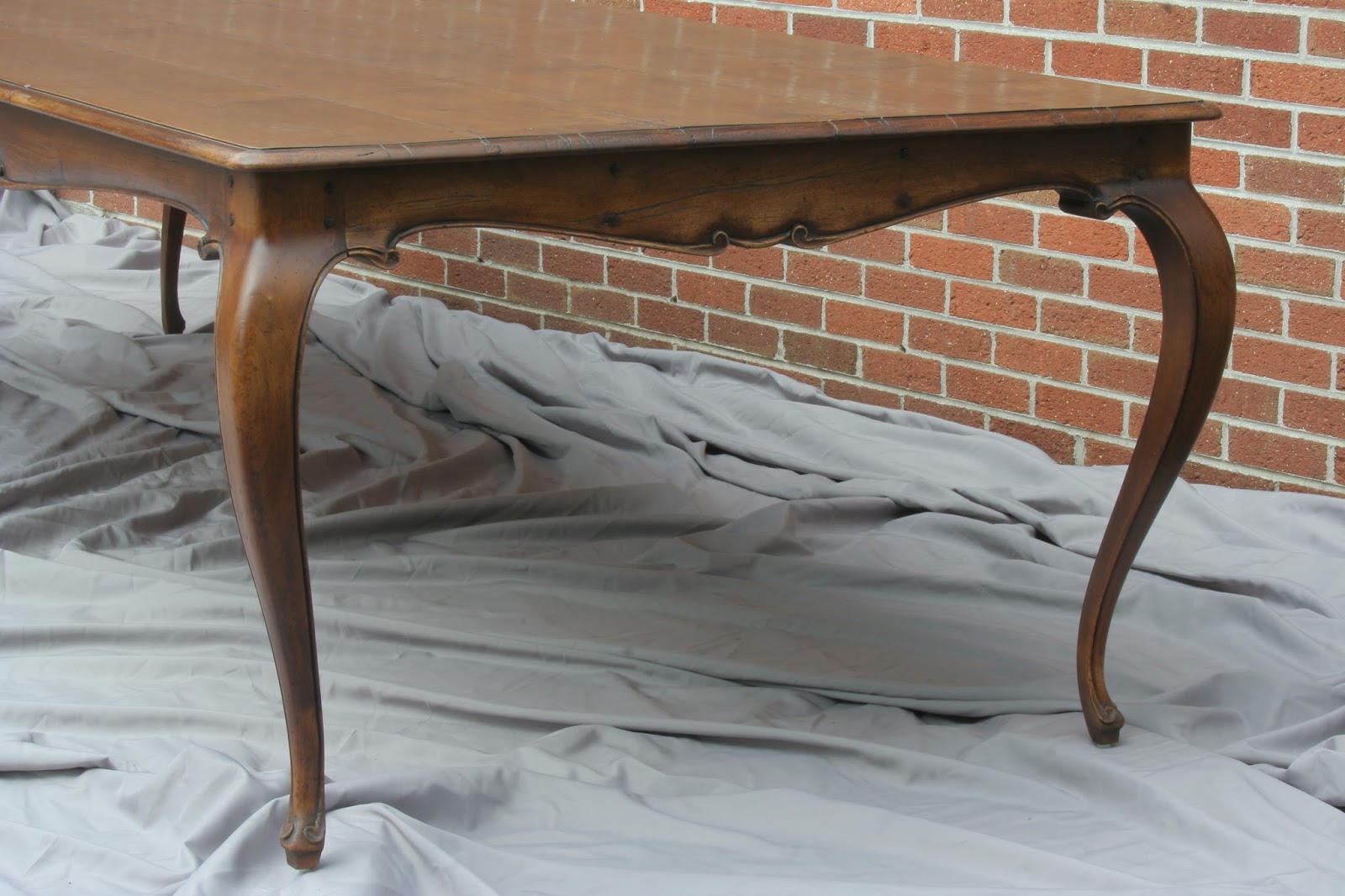
633 Enormous table for Brown Design Group

Another lovely table newly made to order by us with an antiqued finish.  
This one is 11 feet long and 4 feet wide (30 in h.) and is a bespoke order for a client in LA.
The size of the legs was carefully considered - a delicate look was desired and yet they needed to be sturdy enough to support what turned out to be a fairly heavy top, braced from within to support a delicate looking but very substantial cutaway apron.
NO SAG over 11 feet

It was also necessary to reinforce the legs using a steel tension rod, inlaid into the back of the leg where the stress would be the greatest.  A strip of wood is then inlaid over this to hide the brace. 
Shaping the leg
Much time and care was taken in the finish to get this color, which is on the darker side, to show plenty of sunshine

Pictures of the top and apron show round pegs and "cracks" and "gaps" between boards.  All of these cracks and gaps are done for antique effect.
Close view of "cracks" and a spline between each board at the ends.

fake worm holes, fake cracks, fake wear and tear
Of course it gets a living finish so its family can relax and enjoy eating without worry!


Thursday, May 28, 2015

630 Banquette table solid oak made to order

630 Banquette table, English pub style antique finish

A classic, simple and beautiful English pub table and matching bench built and given a distressed antique finish by us.  Design adapted from a 17th century antique.

630 Banquette table, English pub style antique finish

Solid oak table, (28 x 72 x 30h) and bench (12 x 56 x 18h) designed for a family with a new built in banquette in the shape of an L.  The original request was for a traditional farmhouse table, but I suggested a trestle style so that the legs would not be in the way of sliding along the banquette seat.  On a banquette, it is important to choose a table with a very large side and end overhang.

 Off we went to 1stDibs for some inspiration for a trestle table which would please our client, who, up until this point had never seen a trestle style that she liked.  This "Quintessential Early English Oak Trestle Table", was marked for sale (and on hold) for $35,000 at The Fortress.  It left us all awestruck with its simple beauty.  It's from the 17th century and is huge!  It was decided to alter the design as little as possible while scaling down the size to be appropriate for the clients.

630 Banquette table, English pub style antique finish


Shown in construction.  During the design phase, much thought was given to the size and placement of all the elements, and a generous 13 inch end overhang was planned so that knees would not bump in to the sticky-outy bits.  Please see my tab "helpful information" for more logistical stuff about banquette seating and tables.
630 Banquette table, English pub style antique finish

More construction pictures:  as you can see, the entire piece was built of pristine, kiln dried white oak, so all of the "special effects" you are going to see (in the pictures which follow) represent brutalities endured in the finishing process (my department)
630 Banquette table, English pub style antique finish


 The color chosen for this piece was a bit lighter and more peachy-red than the inspiration piece, which appears in a dark neutral walnut.  
 Two functional pegs at each trestle end hold the entire piece together.  A very simple and precisely cut mortise and tenon joint ends in this elegant semicircle, and the entire piece is designed and built so that it ships flat and can be easily assembled at home with regular tools.  
630 Banquette table, English pub style antique finish

 In closeup shots of the table on 1stDibs, an unusual, single round peg showed at the end of the tenon.  It was placed just here, as in our version, and this peg will prevent this tenon end (which endures a lot of stress) from splitting.
630 Banquette table, English pub style antique finish

 Bench ends are done in a similar manner -- knock down mortise and tenon construction and the semicircular end; and one peg instead of two.
630 Banquette table, English pub style antique finish

 Showing top detail.
630 Banquette table, English pub style antique finish

 Very close zoomed in view of top:  heavy "erosion" in the wood is evident as is a scraped away part evoking heavy wear at the ends.
630 Banquette table, English pub style antique finish

 This breadboard end is held in place by small round functional pegs as you can see here.  These allow cross grain movement with the seasons so that the main boards of the top can shrink and expand seasonally, as all solid boards will, without cracking or warping.  I guess it is kind of hysterical that we do all these construction gymnastics to prevent the wood from cracking and then put in all of these fake cracks.
630 Banquette table, English pub style antique finish

 A global view of the entire top, showing variation in color, finish thickness, "cracks", and so on, which we believe would be expected in an old piece.
630 Banquette table, English pub style antique finish

 This shows the bench top which was finished to look a bit smoother and with fewer color variations than the tabletop.
630 Banquette table, English pub style antique finish

Bench.  You would not believe how comfortable this is to sit upon.  The legs can kick back into the middle of the bench and heels rest upon the stretcher.  This feels very nice for the back and posture.


597 Large rustic oval pedestal dining table

A bespoke design for a local client (55 x 75 oval; 30 in h.)  The dining room required an oval.  Our clients did not like the feeling of having table legs in the way of scooting more chairs around the piece when extra guests were around.  A traditional pedestal design was rejected, and this simple rustic base resulted.
"Under the hood" are these graceful shaped arches.  They are high enough not to hit the knees.

Massive stretchers below complete the pedestal. 
This light green-gold finish was chosen to harmonize and contrast. 
The top is pieced and is solid mahogany.  Two massive, 16 inch wide slabs had to be found for the ends.

A nice rich living finish on a very unusual piece. 


Wednesday, April 15, 2015

459 Primitive Artist's Work Table

Here is one that Buck designed and built of pine and alder (36  1/2 x 115 x 30 1/4 h.)  It has an extremely heavily distressed texture.

The story behind this piece is that it used leftover wood from the shop, and was designed and built on spec.  I then intermittently used the table as my workbench in the shop and outdoors for a few years.  The resultant rich color and texture is the result.
A picture of the entire top.  The wood is not raw but is protected with the same living finish we use on many of our other distressed furniture.  The wood has also been chemically hardened.  Despite looking rough, it is quite smooth, and is easily cleaned and will not snag a cloth. 


The side aprons appear large but are actually placed toward the center of the table such that they stay out of the way.  Arm chairs could be used around the entire table, and there is plenty of legroom.
End overhangs are very generous , and again, the end aprons are set back far enough not to bump knees.

Placement of the end stretcher near the floor was carefully considered for comfort while sitting:  resting the legs on that end stretcher is comfortable and natural; and the knees will still miss the apron.


This table is for sale right now; contact us for details: