Monday, May 20, 2013

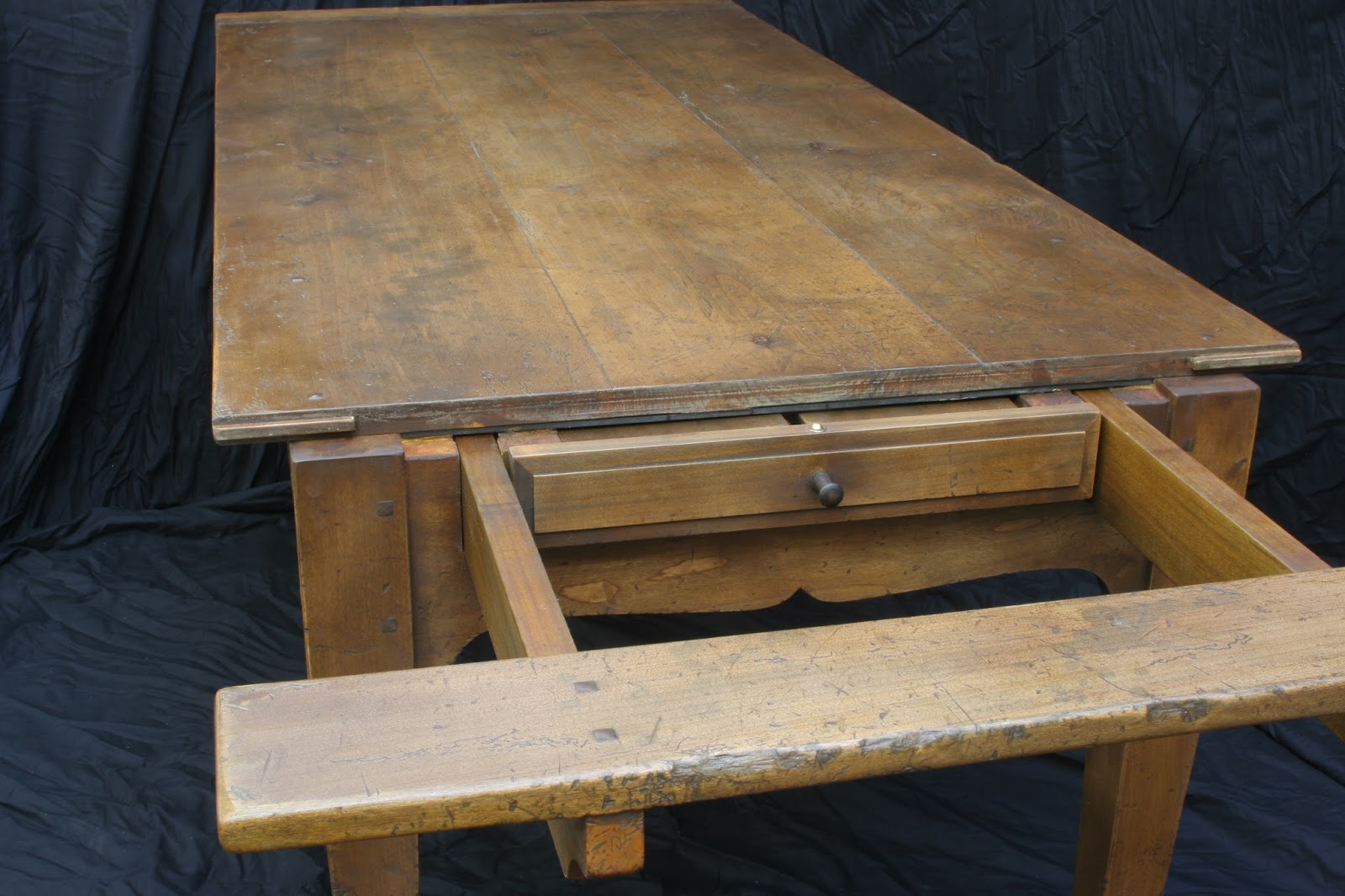
550 Rustic Farmhouse Table

Best ever antique finish.
Close view of the end; this is not reclaimed wood.  Reclaimed wood has issues and must be used very selectively if at all.  There is the ever-present risk of ruining tool knives on hidden staples, nails, birdshot and who-knows-what.  Also, reclaimed wood is not as dry as kiln dried wood and hasn't had water forced out the way only kiln-drying will do.  Wood that starts out having too much moisture content will shrink, crack, distort, and do funny stunts over time; also, if extra moisture is present, finishes will not penetrate as deeply.  Therefore the bulk of our wood we use is new and from a trusted local source.  The "cracks" and other texture marks you see here were done by hand; wood is solid alder and is newly harvested and kiln dried.  
We use alder for a great many of our "antique" pieces because it is readily available, inexpensive, environmentally friendly, and can do a great job of imitating antique fruitwoods.  
Two secrets to an authentic look.  1)  texture 2) color variety.  This is a "green" or environmentally friendly living, penetrating finish; food safe, and performs like crazy.  You will not need to use coasters or placemats but instead freely serve wine, gravy, ketchup and coffee.  Staining substances penetrate reluctantly, and most of the time will blend with the pre-existing distressing.  Liquids penetrate reluctantly, but will also leave the finish (breathing in and breathing out water vapor) without becoming trapped under a crust.  Trapped water vapor under a crust finish  is the source of unsightly rings.  Since this is a penetrating finish, rings are reluctant to form, only doing so under conditions more extreme than normal dining.   Damage is expected as a result of living -- all incidental damage should blend in with existing distressing.  Any damage that is bothersome or more severe can be easily and inexpensively repaired in-home.  
Alder is easy to plane by hand.  This table was hand planed, and the tool marks are worn away so that they are barely discernible.  Alder is easy to coax into an aged fruitwood look when the right colors and effects are applied.  
Showing apron detail and corbel at leg joints.  
Note the round pegs at each joint.  The boards look like separate pieces of wood, and in fact are separate distinct boards; however they are tightly joined together so that spilled liquids do not run through to the floor below.  They may look as if there is a space between them, but the space occurs only at the top edge, not all the way through.

Saturday, May 4, 2013

540 Classic Round


Here is a close view of the top, showing texture and antiquing.  As usual this one has a living finish.  That means it is a finish that allows people to live, eat, drink and breathe easy without worrying about rings and stains and other things that usually ruin table tops.  
Hidden underneath, at the very outside perimeter of this base, are six appliance style levelers, which will make the base as solid as a rock, especially on our client's lovely uneven, wide plank wooden floor. 

A close view of the base, showing antiquing and texture.  

When the piece is done and ready to ship, every out of town client gets a series of pictures, including pictures like this one showing the finish sample against the piece.  This finish sample is color number 35, which is a nice, neutral color that looks like antique walnut.  

The table is made of solid alder, an inexpensive wood that grows like a weed in the Pacific Northwest.  It is therefore a great "green" choice; the texture and grain is lovely, and it can imitate more expensive fruitwoods flawlessly. 

Here is the table in our client's Northern California dining room.  


Friday, May 3, 2013

466b Round Gold Mirror

The dimensions here are 33 1/2 in diameter and 2 1/2 inches thick.  OF COURSE custom sizes and colors are available!!  
Newly built of short hunks of solid poplar and turned on the lathe.  This is what is called a "faceplate turning".  It's a machine that consists of a HUGE plate - 45 inches in diameter or so - that spins at super-high-speed, while the profile is cut with sharp shaped chisels. 
Here is a nice look at the antique effects on the mirror and the heavily distressed gold leaf.  In front of the mirror where it is reflecting is a light grey beige linen cloth - so, wherever you see the light grey beige the mirror is actually silver reflective. 
Underneath the gold leaf are several layers of casein paint, which I trick into crackling and bubbling just enough in all the right places, then distress so that there are layers and complexity.  
Inside, on the "chocolate" border there is just a hint of chalk and dirty-ness.  The whole idea is that the mirror looks genuinely old, but with a fresh and unfussy, but traditional design. 
This view shows the side (which is about 2 1/2 inches thick).  
Here's a very close view showing all the texture.  
Thanks for reading!  This mirror is offered for sale here:  Link to Listing

Tuesday, April 23, 2013

466a Davy Jones Mirror

This is a newly built mirror frame, painted to look old, and a new mirror, stripped and chemically aged to look antique.  The idea here was to create something that looked nautical, as if it had hung in the great stateroom of a luxury liner, which sank - and of course now Davy possesses it.  
The frame is of solid poplar and was turned on a lathe - it's a "faceplate turning" in which the whole thing rotates and the profile is cut with shaped chisels.  

Many layers of distressed casein paint give this finish its complexity.  The antique mirror is in fact brand new.  To antique a mirror properly, one must strip the paint off the back and age it with chemicals that eat away the silver.


Close view of paint and mirror.  This piece measures 33 3/4 inches in diameter and belongs to a local Portland man whose favorite color is grey.  It can be ordered in custom sizes.  

552 Outdoor Table

This trestle table is distressed and finished to look antique.  It is built of solid oak and is very sturdy, and has been finished with a penetrating living finish that will perform outdoors.  Here it is in San Jose California.  
Detail of the end stretcher.  The table comes apart here and could be shipped in pieces to save space.  

Detailing of the aprons and tops of the legs.  This table can easily be built with leaves.  

Detail of top, showing round pegs at each "joint".  There are no actual joints in this table; since it was expected to be exposed to some rain, we built the top with separate boards and coated all six sides of each board with a water resisting, tough and resilient finish.  

This shows fake "cracks" in the wood.  The oak we used here was new and kiln-dried and had no such cracks.  Each one was added by me in order to make the top look like an antique.  

Detail of top.  This is supposed to look 100 years old at least, with spots, cracks, texture, and rough joints and lots of color complexity.  


Very close view of top texture showing round pegs. 


Showing the basic shape and simple trestle design.  We spent quite a bit of time mocking up the end stretcher and making sure that it was comfortable to sit at.  We originally made this table for a tall family.  Many of our customers are tall, and find that genuine antiques are built too low and with too wide of an apron for them.  This table "sits" very well at the end and it is very comfortable to prop the feet on that end stretcher.  Generous end and side overhangs on this piece make it possible to use arm chairs all around.  
Here is an inspiration picture of a genuine 18th Century rustic farmhouse table that the client chose for guidance on the color and finish effects.  It's for sale at www.liveauctioneers.com.

Monday, April 22, 2013

550 Classic farm tables have an antique finish and can be built with leaves


Turned legs and a pullout breadboard leaf system
Close view of turned leg and antiqued finish


This is a 30 x 60 inch table that expands to seat 10.


Leaves are stored inside this end.
A simpler design, straight tapered legs

classic french farmhouse table with antique look in custom sizes
We almost always use newly sawn kiln dried wood for our furniture.  Cracks are fake, wormholes are fake, discoloration is fake.  Pegs are fake too!  For somebody who likes to eat whole foods and wears no makeup, it's rather hysterical that all I do at work is fake finishes.
#610 -- A variation on that theme:  with cabriole legs and "company board leaves".
Simply constructed leaves are attached to leaf arms and fit within slots cut in each end.

Plugs cover these leaf arm holes when the leaf is absent.


#596 -- Another color and style variation:  slightly thinner, straighter legs.  This has pullout style leaves:  Leaf arms are attached to breadboard ends on the table itself.  Breadboard ends pull out to accept a flat leaf. 


#483:  Another variation:  straight tapered legs, pullout breadboard ends, and self storing leaves.
This one has a bench and a cutting board.
Solid oak cutting board
Leaves stack up on that cutting board as shown in following photos:


At the other end, leaves are stored as shown in the following photos: