Monday, April 22, 2013

550 Classic farm tables have an antique finish and can be built with leaves


Turned legs and a pullout breadboard leaf system
Close view of turned leg and antiqued finish


This is a 30 x 60 inch table that expands to seat 10.


Leaves are stored inside this end.
A simpler design, straight tapered legs

classic french farmhouse table with antique look in custom sizes
We almost always use newly sawn kiln dried wood for our furniture.  Cracks are fake, wormholes are fake, discoloration is fake.  Pegs are fake too!  For somebody who likes to eat whole foods and wears no makeup, it's rather hysterical that all I do at work is fake finishes.
#610 -- A variation on that theme:  with cabriole legs and "company board leaves".
Simply constructed leaves are attached to leaf arms and fit within slots cut in each end.

Plugs cover these leaf arm holes when the leaf is absent.


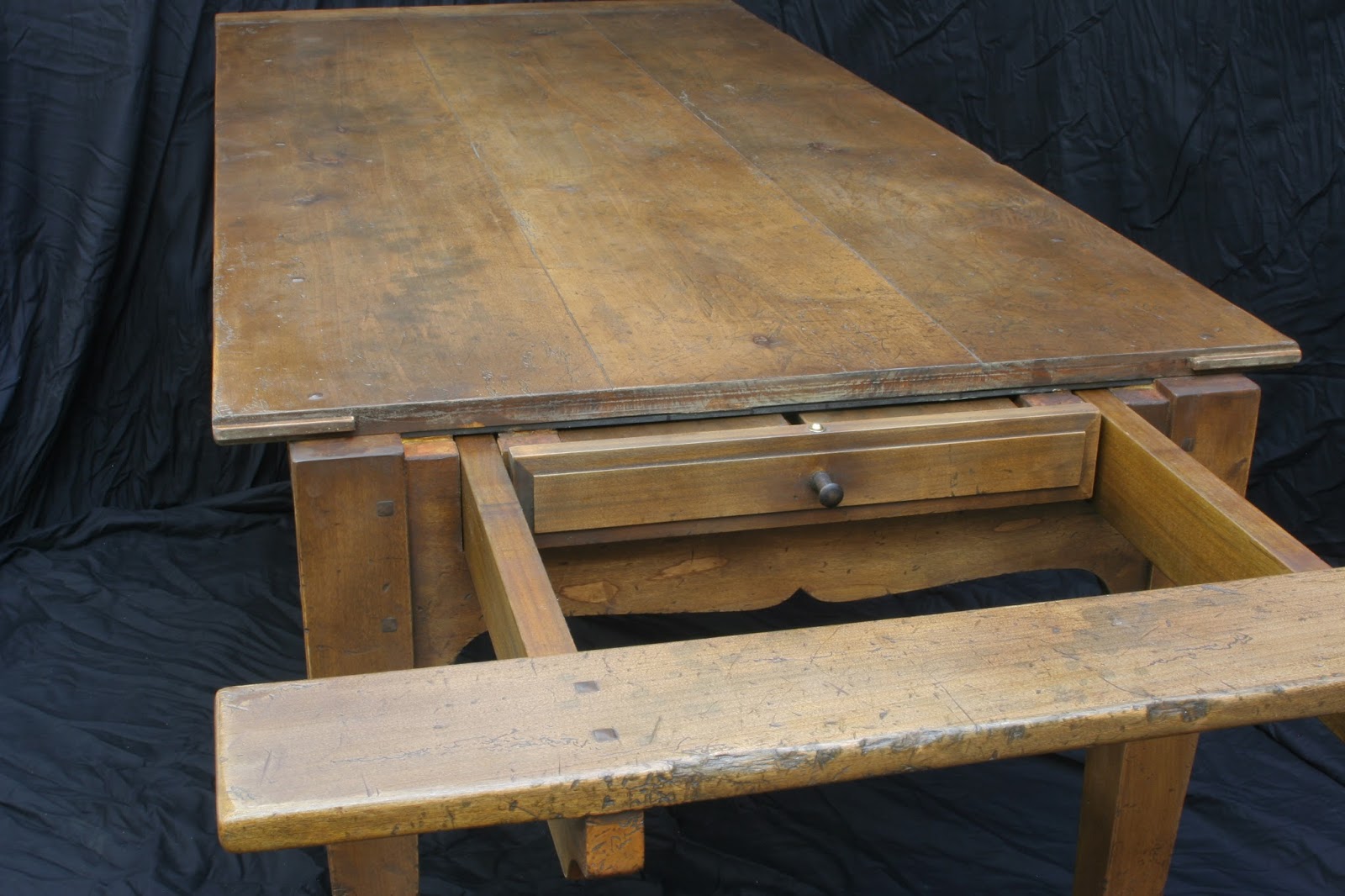
#596 -- Another color and style variation:  slightly thinner, straighter legs.  This has pullout style leaves:  Leaf arms are attached to breadboard ends on the table itself.  Breadboard ends pull out to accept a flat leaf. 


#483:  Another variation:  straight tapered legs, pullout breadboard ends, and self storing leaves.
This one has a bench and a cutting board.
Solid oak cutting board
Leaves stack up on that cutting board as shown in following photos:


At the other end, leaves are stored as shown in the following photos: 


Tuesday, April 16, 2013

542 Curvy French Table

Here is an absolutely beautiful hand carved solid alder dining table that seats 8 generously and squeezes 10.  Dimensions are 40 x 110 on this one; however, we do gladly make custom sizes.  

It wears a living finish (of course) and has a rich, complex, antique walnut finish somewhat on the darker side of normal.  

This one is color #33 which is a nice neutral.  All of these colors are exceedingly complex, which means that they'll harmonize with exactly everything. 

Closer view of the top, showing little round pegs at the joints. 

Showing the end.  


Showing the curvature of the leg.  The thin ankle makes the whole thing look like a very nicely shaped tall woman up on little pointy heels.  A nice feature here is that the apron is rather thicker than one would expect, and this is visible when viewing the table at this angle shown here.  

Showing a close view of the carving, texture, end grain, fake cracks and "worm" damage.  

View of the leg and apron showing how the leg and apron transition together so smoothly and gracefully, with square pegs at the joints.  

Thursday, April 4, 2013

310 Massive Belgian Tables

Here is a beautiful dining table with a sculpted trestle base. 

It has a living distressed finish on solid knotty alder 
It's an extension dining table - those large breadboard ends pull out so that a leaf can be inserted for big parties

It's an extension table, and the breadboard end pulls out on two sturdy leaf arms. 

This picture shows the sturdy and elegant arms and feet

Close view, "under the hood"

Close view of top, showing texture, color and distressing.  The client was enthusiastic about a living finish because she said, the parties always seemed to happen at her house.  She wanted to enjoy the party without worrying about ketchup stains on some crazy precious tabletop. 

Here it shows the shape of the pedestal

Showing leaf arms and trestle arms

Another view. 

Another view of the top:  In most cases, it is ideal for chairs to straddle the feet.  

Wednesday, April 3, 2013

420 Dining room table with salvaged natural fir top, painted distressed base

Here is the inspiration picture for this piece:  Source: stinemos.blogspot.com via Suzanne on Pinterest
These are reclaimed fir boards from old Oregon barns.  We do not use reclaimed wood very often.

Some reasons not to use reclaimed wood are:  high moisture content:  two problems with this:  first, the wood will shrink in width and may warp over time.  second, moisture inhibits finish penetration.  More problems with salvaged wood:  birdshot and nails which ruin knives // rot and fragility // SPLINTERS // 

Salvaged wood, if it is ever to be used, must be done strategically - we would never use it for anything except a top such as this one.  The boards did not come straight off the barn looking like this and required hours upon hours of manipulation to impart a soft blonde color; (their natural inclination under oils is toward a screeching dark orange) harden the soft spots (90 percent of the entire board); add "convincing" "worm" holes with an awl (these are NOT natural; this is Oregon, the natural ones were HUUUGE); re-create the eroded, up and down grain on the cut ends and any areas that had to be shaped; and  de-splinterize the entire length so that it could be wiped with a rag.  

This close view of the foot shows a lot of wear here, as it should be.  The base coat was avocado, and the intermediate coat a soft dove grey.  


Showing a little bit of crackle here and there...


The finished piece went to live in Wisconsin.

Sunday, February 10, 2013

531 Gustavian Sideboard

Here is a rustic dining room sideboard with an antique Swedish look.  It went to live in Forest Hills, New York.

Here is a close view of the brass chicken wire door panels.  These have been aged so that the brass looks old. 

Here's a close view of the top.  It is a multi layered casein paint that has been given a heavily distressed look.  I really love it when a client is willing to pull the "ultra-heavy" trigger on the distressing level and go bold with color. 

Front view...


Sunday, November 4, 2012

517 Old World Dining

The piece here sits in our client's gorgeous dining room designed by Jennifer Flanders of New York
Showing in background is our sideboard in a Gustavian finish of dark ivory and robin's egg blue.  The room will get one more piece of furniture designed and built by us (not shown at current time).  


This is a very rustic dining table with pullout breadboard ends, and two leaves.


Showing Breadboard end.


Measuring 54x98 it will seat 8 comfortably with no leaves in place, and will expand to 134" long (11 ft) to seat 14 with both leaves in place. 


Close view of end.  Since the table is so large, it was built to disassemble easily.  Hidden behind this rectangle is a lag screw which attaches the trestle ends to the stretcher at the floor.  


It has a hand planed surface and wears our popular  "living finish" because it is easy to live with, looks natural and alive, and will age beautifully without needing any protection from place mats or coasters. 


 It is a distressed, durable and easily repairable penetrating oil finish which gives the table a very authentic looking antique look and feel.  Shown here are square pegs at joints of top, and "worm damage".  
Another close view of top showing "cracks" and square pegs and distressing marks.  


Underneath one of the breadboard ends is this beautiful inscription in letters about 2 or 3 inches high.   The parents plan to hand this table down to future generations.